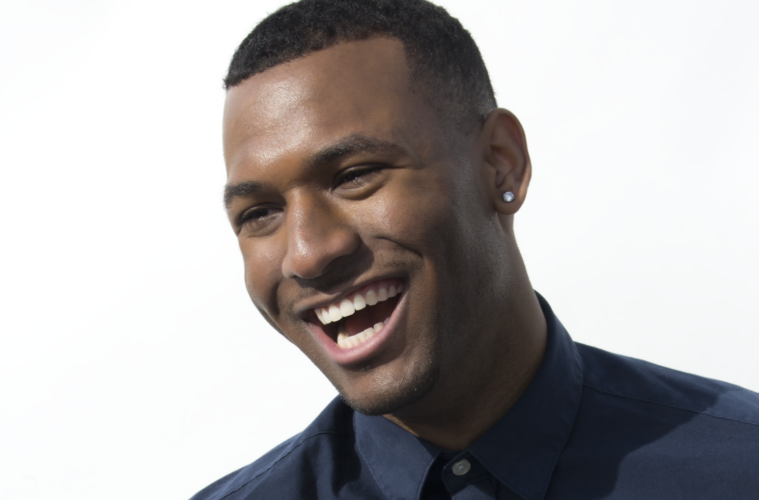
All men are scared of one thing: not being enough. The threat is everywhere you turn: the muffled laughter of boys behind you, the weird stare of girls as you w... Go Deeper
We’re told that if you look and act a certain way, the world and everything in it can be yours. So we toil toward perfection, changing ourselves based on the op... Go Deeper
Not many men will admit their shortcomings--and certainly not publicly. But during our interview, Brian, an early-twentysomething from Queens, was qui... Go Deeper
If society says that most men are incapable of intimacy, Brian, an early-twentysomething from Queens, would be proof that society doesn’t have a clue. Instead, ... Go Deeper
What’s the first thing that comes to mind when you put “intimacy” and “man” in the same sentence? Is he a willing participant? Is he fully invested in being in ... Go Deeper
Jarren, a late twentysomething from the West Coast, is of African and European descent. A 6 foot 3 former football player at Yale, he’s aware of his beauty and ... Go Deeper
“There are two things men desperately need from one another that, generally speaking, they are not getting or giving: permission to express their deepest feelin... Go Deeper
Types of Interviews & What to Expect
The time commitment for this project varies depending on your desired involvement. There are three different types... Go Deeper
Is it possible that the standard of beauty can be oppressive, even for men who meet it? It seems counterintuitive, but Jarren, a late-twentysomething from the W... Go Deeper
Storyteller, creative, and educator constantly dreaming up new ways to bring social change to the masses.
Pin It on Pinterest
The Healing Literacy Framework
In 2019, Keith F. Miller, Jr., observed something remarkable while running creative writing after school programs in Savannah, GA: Students from all backgrounds didn’t just step outside their comfort zones—they learned, led, and thrived with unmistakable joy. Despite this, Keith heard from students and families that school, even for the high-achievers, was a place they survived, not thrived. This led Keith, through his studies in Educational Psychology, to explore why young people felt empowered to learn, lead, and heal in some spaces but not in others.
Through a qualitative research study involving interviews with high schoolers, fellow teaching artists over a year, in addition to examining creative works from youth journals and performances, Keith found that when young people engage in arts-based healing practices with trusted others (peers and adults), they don’t just cope with their struggles—they transform them, becoming vibrant leaders in the process.
Drawing inspiration from the process of rainbow formation—reflection, refraction, and dispersion—and building off of groundbreaking research from scholars like David Kirkland, Gholdy Muhammad, Bettina Love, Bianca Baldridge, and Shawn Ginwright, Keith developed the Healing Literacy Framework, illustrating how arts-based, community programs are vital in supporting young people as they overcome educational trauma, and, in doing so, can result in transformative partnerships in school and beyond that prove healing is possible for everyone.
Enter, HEALIT
In 2019, Keith F. Miller, Jr., observed something remarkable while running creative writing after school programs in Savannah, GA: Students from all backgrounds didn’t just step outside their comfort zones—they learned, led, and thrived with unmistakable joy. Despite this, Keith heard from students and families that school, even for the high-achievers, was a place they survived, not thrived. This led Keith, through his studies in Educational Psychology, to explore why young people felt empowered to learn, lead, and heal in some spaces but not in others.
Through a qualitative research study involving interviews with high schoolers, fellow teaching artists over a year, in addition to examining creative works from youth journals and performances, Keith found that when young people engage in arts-based healing practices with trusted others (peers and adults), they don’t just cope with their struggles—they transform them, becoming vibrant leaders in the process.
Drawing inspiration from the process of rainbow formation—reflection, refraction, and dispersion—and building off of groundbreaking research from scholars like David Kirkland, Gholdy Muhammad, Bettina Love, Bianca Baldridge, and Shawn Ginwright, Keith developed the Healing Literacy Framework, illustrating how arts-based, community programs are vital in supporting young people as they overcome educational trauma, and, in doing so, can result in transformative partnerships in school and beyond that prove healing is possible for everyone.