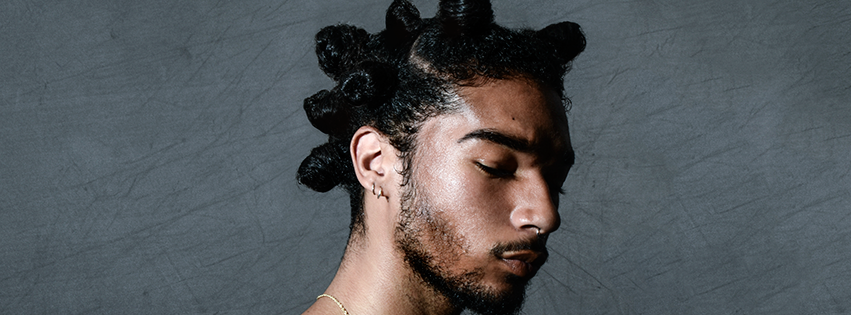
LaQuann, an early-twentysomething who lives in New York City, stands out from the crowd.
And although his beauty and wonderfully lush afro might be the first thing that catches your eye, it isn’t the only reason. A keen observer who is comfortable with listening first, LaQuann embodies a quiet confidence that you immediately realize didn’t happen overnight, but was the product of soul searching at young age.
What really tops the cake, is that he is deeply curious about all things related to masculinity, which he explores through photography and modeling on his blog, Lackwhen.
As you’ll soon learn, a powerful teacher, example, and friend in this process has been his father. And although their relationship hasn’t always been easy, both are reaping the great rewards that can only come from accepting and embracing one another for who they are, while making room for the powerful men they are to be.
In 2019, Keith F. Miller, Jr., observed something remarkable while running creative writing after school programs in Savannah, GA: Students from all backgrounds didn’t just step outside their comfort zones—they learned, led, and thrived with unmistakable joy. Despite this, Keith heard from students and families that school, even for the high-achievers, was a place they survived, not thrived. This led Keith, through his studies in Educational Psychology, to explore why young people felt empowered to learn, lead, and heal in some spaces but not in others.
Through a qualitative research study involving interviews with high schoolers, fellow teaching artists over a year, in addition to examining creative works from youth journals and performances, Keith found that when young people engage in arts-based healing practices with trusted others (peers and adults), they don’t just cope with their struggles—they transform them, becoming vibrant leaders in the process.
Drawing inspiration from the process of rainbow formation—reflection, refraction, and dispersion—and building off of groundbreaking research from scholars like David Kirkland, Gholdy Muhammad, Bettina Love, Bianca Baldridge, and Shawn Ginwright, Keith developed the Healing Literacy Framework, illustrating how arts-based, community programs are vital in supporting young people as they overcome educational trauma, and, in doing so, can result in transformative partnerships in school and beyond that prove healing is possible for everyone.
Enter, HEALIT
In 2019, Keith F. Miller, Jr., observed something remarkable while running creative writing after school programs in Savannah, GA: Students from all backgrounds didn’t just step outside their comfort zones—they learned, led, and thrived with unmistakable joy. Despite this, Keith heard from students and families that school, even for the high-achievers, was a place they survived, not thrived. This led Keith, through his studies in Educational Psychology, to explore why young people felt empowered to learn, lead, and heal in some spaces but not in others.
Through a qualitative research study involving interviews with high schoolers, fellow teaching artists over a year, in addition to examining creative works from youth journals and performances, Keith found that when young people engage in arts-based healing practices with trusted others (peers and adults), they don’t just cope with their struggles—they transform them, becoming vibrant leaders in the process.
Drawing inspiration from the process of rainbow formation—reflection, refraction, and dispersion—and building off of groundbreaking research from scholars like David Kirkland, Gholdy Muhammad, Bettina Love, Bianca Baldridge, and Shawn Ginwright, Keith developed the Healing Literacy Framework, illustrating how arts-based, community programs are vital in supporting young people as they overcome educational trauma, and, in doing so, can result in transformative partnerships in school and beyond that prove healing is possible for everyone.
 Keith F. Miller, Jr.