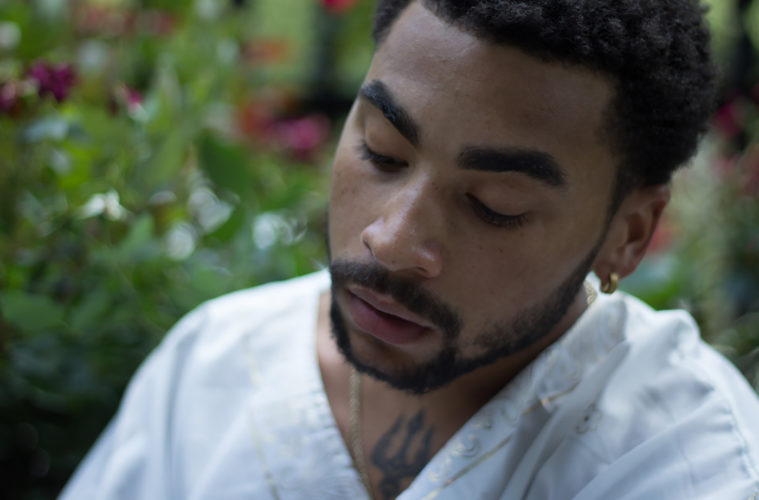
If you ask Brandon if he feels he’s beautiful, he’ll say, “From the chin up.” That’s because people seem to rarely resist the urge to complement his hazel-brown... Go Deeper
In the book-length letter to his son, Between the World and Me, Tanehisi Coates says, “You are growing into consciousness, and my wish for you is that you feel ... Go Deeper
Anthony, an early-twentysomething from New Jersey and North Carolina, is on an unforgettable journey. To re-discover himself. To understand the force of nature ... Go Deeper
Sometimes, being ourselves is a radical act. In doing so, we make a statement to the world that we won’t be broken or influenced by society but instead commit o... Go Deeper
Everyone has a story, a past. A collection of people, things, and experiences that play a powerful role in shaping the who we are and who we hope to be.
At ti... Go Deeper
How often do we sit down and try to put what we’re yearning for in words? Name that thing we are drawn to and hope to build with those special in our lives. Not... Go Deeper
Alexey, an early-thirtysomething from Kazakhstan, has a face and spirit you’ll never forget. So, it’s no surprise he spent his first several years in New York C... Go Deeper
Greek philosopher Atticus hit the nail right on the head when he told us, “Watch careful the magic that occurs when you give a person just enough comfort to be ... Go Deeper
Few people know the demands of beauty more than fashion models.
The rejection. Being made to feel small. Not being in control of whether you have “it” or not. ... Go Deeper
Have you enjoyed what you’ve experienced so far on The Pillow Talk Project and you want to get involved? Whether it be photography or writing, you’ve come to th... Go Deeper
Storyteller, creative, and educator constantly dreaming up new ways to bring social change to the masses.
Pin It on Pinterest
The Healing Literacy Framework
In 2019, Keith F. Miller, Jr., observed something remarkable while running creative writing after school programs in Savannah, GA: Students from all backgrounds didn’t just step outside their comfort zones—they learned, led, and thrived with unmistakable joy. Despite this, Keith heard from students and families that school, even for the high-achievers, was a place they survived, not thrived. This led Keith, through his studies in Educational Psychology, to explore why young people felt empowered to learn, lead, and heal in some spaces but not in others.
Through a qualitative research study involving interviews with high schoolers, fellow teaching artists over a year, in addition to examining creative works from youth journals and performances, Keith found that when young people engage in arts-based healing practices with trusted others (peers and adults), they don’t just cope with their struggles—they transform them, becoming vibrant leaders in the process.
Drawing inspiration from the process of rainbow formation—reflection, refraction, and dispersion—and building off of groundbreaking research from scholars like David Kirkland, Gholdy Muhammad, Bettina Love, Bianca Baldridge, and Shawn Ginwright, Keith developed the Healing Literacy Framework, illustrating how arts-based, community programs are vital in supporting young people as they overcome educational trauma, and, in doing so, can result in transformative partnerships in school and beyond that prove healing is possible for everyone.
Enter, HEALIT
In 2019, Keith F. Miller, Jr., observed something remarkable while running creative writing after school programs in Savannah, GA: Students from all backgrounds didn’t just step outside their comfort zones—they learned, led, and thrived with unmistakable joy. Despite this, Keith heard from students and families that school, even for the high-achievers, was a place they survived, not thrived. This led Keith, through his studies in Educational Psychology, to explore why young people felt empowered to learn, lead, and heal in some spaces but not in others.
Through a qualitative research study involving interviews with high schoolers, fellow teaching artists over a year, in addition to examining creative works from youth journals and performances, Keith found that when young people engage in arts-based healing practices with trusted others (peers and adults), they don’t just cope with their struggles—they transform them, becoming vibrant leaders in the process.
Drawing inspiration from the process of rainbow formation—reflection, refraction, and dispersion—and building off of groundbreaking research from scholars like David Kirkland, Gholdy Muhammad, Bettina Love, Bianca Baldridge, and Shawn Ginwright, Keith developed the Healing Literacy Framework, illustrating how arts-based, community programs are vital in supporting young people as they overcome educational trauma, and, in doing so, can result in transformative partnerships in school and beyond that prove healing is possible for everyone.