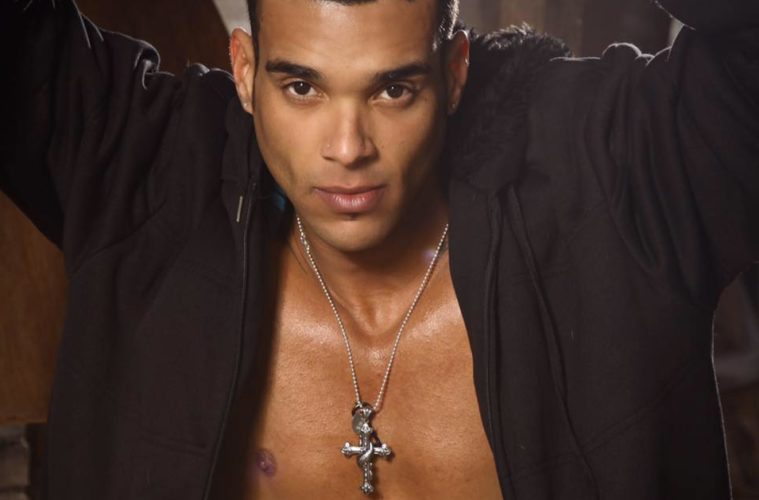
DeAndre, a late-twentysomething now living in New York City, is certainly more than meets the eye.
A bundle of warm energy, he’s sure to light up a room. But t... Go Deeper
We talk a lot about the power of intimacy and why it’s important. But what’s often left unsaid is how it makes us feel.
For someone like DeAndre, who struggles... Go Deeper
It isn’t always talked about, but those we consider beautiful don’t always feel that way. In a society dominated by social media, it can be hard to believe, but... Go Deeper
If we’re fortunate, we all experience that special someone in our lives who shows us what it really feels like to be in love. For a privileged few, that relati... Go Deeper
Arick, an early-twentysomething Taiwanese American, is bold in more ways than one.
With a beautiful mind that doesn’t shy away from the hard questions, he pond... Go Deeper
Have you ever considered being in an open relationship? Better yet, have you ever wanted to connect with someone else on a sexual level, even though you were al... Go Deeper
Arick was walking down the street in Seattle, and then a guy walked up to him and screamed, “Hey, I want to eat your ass!” He was disoriented. He’d never experi... Go Deeper
Jamaal, an early-thirtysomething who lives in Los Angeles, California is the perfect example of what it means to know the power of your testimony.
With warm, b... Go Deeper
One of my favorite poems by Langston Hughes is Dream Deferred, where he explores what happens to the dreams that never get to materialize.
But Jamaal’s story a... Go Deeper
As young kids, we rarely know exactly where we’ll end up. Jamaal is no different. After listening to Kenny G with his father, he had one goal: to play the saxop... Go Deeper
Storyteller, creative, and educator constantly dreaming up new ways to bring social change to the masses.
Pin It on Pinterest
The Healing Literacy Framework
In 2019, Keith F. Miller, Jr., observed something remarkable while running creative writing after school programs in Savannah, GA: Students from all backgrounds didn’t just step outside their comfort zones—they learned, led, and thrived with unmistakable joy. Despite this, Keith heard from students and families that school, even for the high-achievers, was a place they survived, not thrived. This led Keith, through his studies in Educational Psychology, to explore why young people felt empowered to learn, lead, and heal in some spaces but not in others.
Through a qualitative research study involving interviews with high schoolers, fellow teaching artists over a year, in addition to examining creative works from youth journals and performances, Keith found that when young people engage in arts-based healing practices with trusted others (peers and adults), they don’t just cope with their struggles—they transform them, becoming vibrant leaders in the process.
Drawing inspiration from the process of rainbow formation—reflection, refraction, and dispersion—and building off of groundbreaking research from scholars like David Kirkland, Gholdy Muhammad, Bettina Love, Bianca Baldridge, and Shawn Ginwright, Keith developed the Healing Literacy Framework, illustrating how arts-based, community programs are vital in supporting young people as they overcome educational trauma, and, in doing so, can result in transformative partnerships in school and beyond that prove healing is possible for everyone.
Enter, HEALIT
In 2019, Keith F. Miller, Jr., observed something remarkable while running creative writing after school programs in Savannah, GA: Students from all backgrounds didn’t just step outside their comfort zones—they learned, led, and thrived with unmistakable joy. Despite this, Keith heard from students and families that school, even for the high-achievers, was a place they survived, not thrived. This led Keith, through his studies in Educational Psychology, to explore why young people felt empowered to learn, lead, and heal in some spaces but not in others.
Through a qualitative research study involving interviews with high schoolers, fellow teaching artists over a year, in addition to examining creative works from youth journals and performances, Keith found that when young people engage in arts-based healing practices with trusted others (peers and adults), they don’t just cope with their struggles—they transform them, becoming vibrant leaders in the process.
Drawing inspiration from the process of rainbow formation—reflection, refraction, and dispersion—and building off of groundbreaking research from scholars like David Kirkland, Gholdy Muhammad, Bettina Love, Bianca Baldridge, and Shawn Ginwright, Keith developed the Healing Literacy Framework, illustrating how arts-based, community programs are vital in supporting young people as they overcome educational trauma, and, in doing so, can result in transformative partnerships in school and beyond that prove healing is possible for everyone.